
I had the opportunity to attend and volunteer at the Symposium on Operating Systems Principles (SOSP 2025) held in Seoul, South Korea, one of the most prestigious and influential conferences in systems research. This event brought together researchers, engineers, and practitioners from around the world to discuss groundbreaking advances in operating systems, distributed computing, storage, and AI systems. As a volunteer, I was assigned to the registration and attendee support desk, where I helped participants with check-in procedures, guided them to their sessions, and assisted with logistics throughout the conference. This experience allowed me to interact directly with distinguished academics, industrial researchers, and graduate students from leading institutions. It was rewarding to contribute to the smooth organization of such a major international event while building meaningful connections across the global research community.
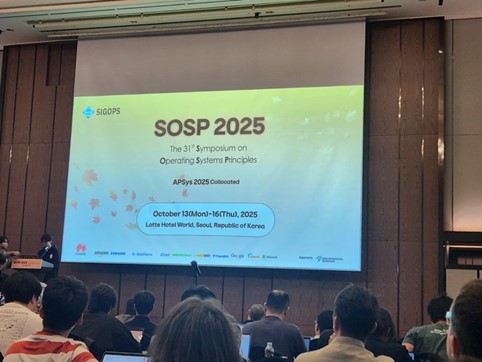
Beyond my volunteer duties, I also attended several keynote lectures and paper sessions, gaining valuable insights into the latest trends in systems design, cloud computing, and AI-driven resource management. The sessions that I was particularly interested in were the LithOS and TrainVerify. LithOS proposes a GPU operating system that improves utilization and energy efficiency through fine-grained control. It introduces a TPC scheduler, kernel atomizer, and dynamic power/right-sizing mechanisms to manage GPU resources transparently across workloads. This design significantly reduces tail latency and power consumption, paving the way for future OS-level GPU management. While TrainVerify presents a formal verification system for distributed LLM training, it ensures that complex parallel execution plans remain mathematically equivalent to the original model. Using symbolic data-flow graphs, stage-wise verification, and shape reduction, it detects and eliminates parallelization bugs, providing correctness guarantees even for large-scale models like Llama-3 and DeepSeek-V3
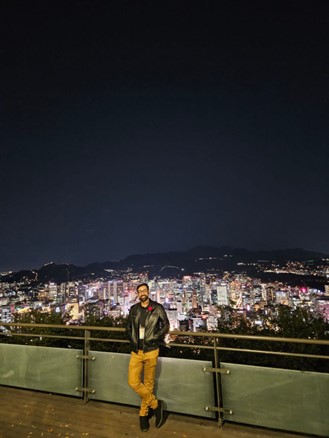
Beyond the conference halls, SOSP 2025 also offered an excursion trip to Bokcheon Palace and N Seoul Tower, where I volunteered as a guide for international attendees. It was a rewarding experience to share insights about Seoul’s culture and history while connecting with researchers from around the world in a more informal setting.
Overall, participating in SOSP 2025, both as an attendee and volunteer, was an inspiring and unforgettable experience. It strengthened my professional network, expanded my perspective on systems research, and reinforced my motivation to contribute to the global systems and AI community.